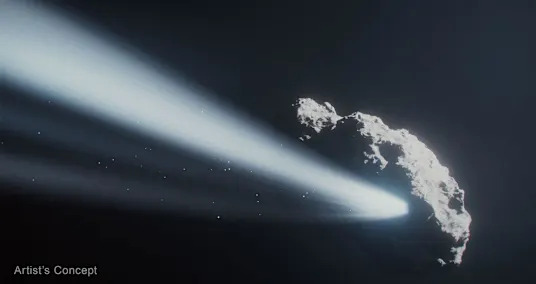
Astronomers have found archival data showing a one-of-a-kind event where a spinning comet appeared to reverse the direction of its rotation, NASA said in a news release.
The comet, named 41P/Tuttle-Giacobini-Kresák, originated in the outer solar system and visits the inner solar system every 5.4 years, NASA said. During a pass around the sun in 2017, its rotation dramatically slowed. A data comparison of its movements showed that in May 2017, it rotated three times more slowly than in March of that year.
Recently, NASA scientists conducted a new analysis of those observations and saw that the comet had made even more surprising moves. Images from December 2017 showed the comet spinning faster than in May.
Researchers determined that the comet likely continued slowing until it nearly stopped. Then, as it approached the sun, heat melted frozen ice on the comet's surface, creating "jets of gas" that "can act like small thrusters," said David Jewitt, an astronomer at the University of California at Los Angeles who published a paper about the comet's movements. The comet also had a small nucleus, making it easy for it to rotate.
Eventually, the jets' push against the original motion slowed it down until they eventually forced the comet to spin the other way. An animated video by NASA shows an artist's rendering of the process.

"It's like pushing a merry-go-round," Jewitt said in NASA's news release. "If it's turning in one direction, and then you push against that, you can slow it and reverse it."
Jewitt said he expects the nucleus will "very quickly self-destruct." Archival data from its 2001 passage shows the comet was very active at the time, and scientists were able to determine that activity had decreased significantly by 2017. The comet's surface may be evolving quickly, NASA said. Typically, comets evolve over centuries, but because of the comet's rotational shifts, the changes are happening faster.
Continued rotational changes might mean the comet eventually becomes unstable, potentially leading to its fragmentation or disintegration, NASA said.
NASA said the discovery shows the importance of the space agency's publicly accessible data.
"Observations made years, or even decades ago, can be revisited to answer new scientific questions," the agency said. "In many cases, scientists continue to make discoveries not just with new observations, but by mining the archive built over decades of space exploration."
Latest on jury deliberations in California social media addiction case
Trump reveals Iran apparently gifted the U.S. boats of oil that moved through Strait of Hormuz
Congress prepares to vote on DHS funding that could end TSA chaos
latest_posts
- 1
 Experts who once backed 'shaken baby' science now fight to free imprisoned caregivers
 - 2Untamed life Safe-havens All over the Planet Offering Remarkable Creature Experiences
- 3Would you ever turn to AI for companionship? 6% of Americans say they could — or already have.
- 4Paratroopers kill terrorist who threw rocks at Israeli citizens, soldiers near Ofra in West Bank
- 5When Would it be a good idea for you to Look for Help from a Criminal Legal counselor?


- Baidu robotaxi outage in Wuhan caused by 'system failure', police say
- Eight Muslim nations condemn Israel's 'dangerous' new death penalty law
- Health officials report 14 Legionnaires' disease cases in Florida, gym connection suspected
- Hunger and makeshift shelters persist in north Caribbean nearly 2 months after Hurricane Melissa
- Figure out how to Detect the Best Rooftop Substitution Choices
- Is Chinese food truly flavorful?
- CDC's upcoming vote on hepatitis B vaccine could impact childhood immunization
- All the eclipses, supermoons, meteor showers and planets to spot in 2026
- Ukrainian foreign minister appeals for funds for drones