TSAKANE, South Africa (AP) — Gladys Khoza had missed being able to see her family. Not because they couldn't visit, but because the 84-year-old had vision problems.
Now that has changed. Khoza is one of 133 people whose sight was restored during a “marathon” of free cataract surgeries conducted by doctors in South Africa at two hospitals over two weekends last month.
“Wow!” a delighted Khoza whispered as a nurse peeled back a bandage a day after her operation, and the world came back into view.
“Can you see me?” the nurse asked. “Very well,” Khoza replied, a big grin on her face.
Patients in South Africa's public health service can be on waiting lists for years for the simple 15-20-minute cataract operation. Officials said some of those who were selected from hospital waiting lists for the surgeries had been waiting since 2019 to see properly again.
Cataracts are a common, often age-related condition in which the eye's lens becomes clouded, and they are the leading cause of curable blindness. The surgeries insert a new artificial lens.
For Khoza, who said she couldn't see anything out of one eye because of a cataract and had long had issues with the other, the simple surgery equates to a major boost for her quality of life.
“I just wanted to be able to see,” she said. Now, after nearly a year of waiting, some of her favorite things — seeing loved ones, reading her Bible and watching late-night soap operas — are all possible again.
Dr. Tebogo Fakude, one of the doctors who volunteered to perform the operations at two regional hospitals near Johannesburg, said his mother was blind and that having sight restored is “beautiful.”
"It's beautiful because it alleviates depression,” Fakude said adding that the sense of being a burden was also eased.
Globally, more than 2 billion people suffer from some kind of vision impairment, according to the World Health Organization. For half of them, the problem could have been prevented, or they are still waiting for treatment.
Nearly 100 million people are affected by cataracts, and half of them still need access to surgery, according to the WHO. In Africa, that figure rises to 75% of people without surgery, according to a study published in March by the Lancet medical journal.
Surgery backlogs are a significant problem in South Africa, where government-run hospitals serve more than three-quarters of the population of 62 million people. Limited resources mean emergency procedures and more serious operations are prioritized over elective surgery.
The Health Department-led surgical marathons were first staged on Mandela Day in 2023 to commemorate the legacy of the country’s first Black president, Nelson Mandela. They have developed into a public-private partnership that takes place several times a year to increase access to care.
The ministry has vowed to use surgical marathons as a means of eliminating backlogs. Previous ones have addressed prostate, cleft palate and stomach issues.
Cataracts became the latest focus. Around 300,000 new cases are diagnosed every year in South Africa, Fakude said.
Health groups say South Africa faces a backlog of over 240,000 people waiting for cataract operations. Over 35,000 people in the most populous province of Gauteng — where the surgery marathon was performed — have cataract-related blindness.
WHO says eye cataract operations are “one of the most cost-effective medical procedures,” and a powerful tool to restore someone's independence, dignity and opportunities.
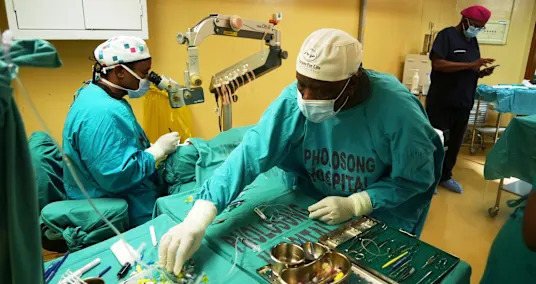
During the three-day surgery marathon at Pholosong Regional Hospital, a new patient was brought into the operating theater about every 30 minutes. Soothing gospel music played on speakers to keep up doctors' morale.
Looking through a microscope, the eye specialists made tiny incisions for each operation, removed the cloudy lens and replaced it with an artificial one. At one point, two surgeons worked concurrently on separate patients to quicken the pace. They completed 60 surgeries on the last weekend of the marathon.
Molefe Mokoena, 72, said he was looking forward to regaining his independence after suffering from a cataract for four years.
"I want to see my great-grandchildren,” he said. “I want to drive my car, and I'm happy about this.”
___
For more on Africa and development: https://apnews.com/hub/africa-pulse
The Associated Press receives financial support for global health and development coverage in Africa from the Gates Foundation. The AP is solely responsible for all content. Find AP’s standards for working with philanthropies, a list of supporters and funded coverage areas at AP.org.
latest_posts
- 1
 The 10 Most Compelling Forerunners in Innovation
- 2How food assistance programs can feed families and nourish their dignity
- 3I'm an 83-year-old yoga instructor. I'm not your typical grandma — I still work to feel fulfilled and supplement my Social Security.
- 4The most effective method to Succeed in Your Web based Advertising Degree: Procedures for Progress
- 519 Peculiar Films You Shouldn't Watch With Your Mum



- Going with Children: Tips for Tranquil Family Get-aways
- Spanish police and soldiers track boars, reinforce farm security amid swine fever outbreak
- The Eastern Bongo, Kenya’s Rare Forest Antelope on the Brink
- Becoming the best at Discussion: Individual Procedures
- 7 Powerful Techniques to Boost Efficiency with Your Cell Phone: A Thorough Aide
- Roche breast cancer pill cuts risk of disease recurrence by 30% in trial
- There are thousands of aligned holes in Peru. Archaeologists now think they know who made them
- Astronauts beam home Christmas wishes from International Space Station: 'I think we may be orbiting a little higher than Santa' (video)
- 'Pluribus' release date: Everything you need to know about the new series from 'Better Call Saul's' co-creator